Today I decided to take the tram to go to work. Sitting there I started to have a look at Twitter, as most of the people around me were doing. It was then when my attention was caught by a title: “Before Islam: When Saudi Arabia was a Jewish Kingdom“. Saudi Arabia was…what? When? Am I missing something?. Yes, my stop.
But it was a totally unexpected article, full of things that made me think, and still are.
The article
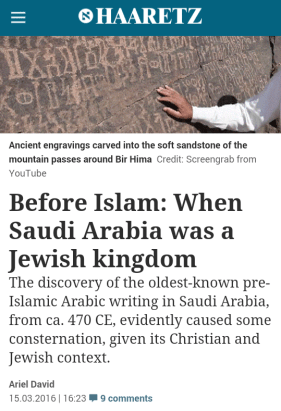 The article was published on March 15th, 2016 in the Israeli newspaper Haaretz, penned by Ariel David, a Tel Aviv-based foreign correspondent for Italian and English-language publications.
In fact, what caught my eye was not only the title itself but the subtitle that completed and explained it: “The discovery of the oldest-known pre-Islamic Arabic writing in Saudi Arabia, from 470 CE, evidently caused some consternation, given its Christian and Jewish context.”
The combination of all these intrigued me: Saudi Arabia – Jewish – pre-Islamic inscriptions – consternation.
In a couple of seconds, it reminded me of the beautiful lecture over pre-Islamic inscriptions given by Laila Nehmé I attended in December 2014. Also, the polemical tone made me think of the research I completed for my BA thesis about the polemics over the Sana’a manuscripts and their reception in the news.
The content of Ariel David’s article is quite interesting: the author starts discussing the findings of pre-Islamic inscriptions in Saudi Arabia and then actually he digs more in details in the history of the Kingdom of Himyar and the Himyarites, leaving the pre-Islamic inscriptions behind, almost unnoticed. A proof for this is that the comments below (last accessed March 16th, 2016) are all about the Himyarites and not about the inscriptions that feature in the titles.
Anyhow, since I am interested in Islamic and Arabic epigraphy, I will leave the Himyarite part to someone else, more prepared in the topic, and will focus on the first part of the article.
I do not personally understand why from discussing pre-Islamic inscriptions in the first paragraph, the author ends the article citing the Yemenite Jews brought to Israel in 1949-50. But who am I to judge? I started this post writing about me going to the office…
The importance of these inscriptions
As Ariel David explains rightly in his article, the inscriptions found around Bir Hima, Saudi Arabia, are extremely important. They display a kind of script that clearly links the Nabatean with the Arabic alphabet. It is like finding the missing link: these inscriptions can add new insights in the study of the Semitic palaeography.
As I already have had the chance to explain, these set of inscriptions will affect our understanding of the Arabic script that emerged from the Nabatean. They can provide us with more clues about where, when and how the Arabic script originated.

The bias – the weight of a single word choice
An article is all about words, needless to say. In this case, the word choice is questionable right from the start.
The title is misleading and biased: Before Islam: When Saudi Arabia was a Jewish kingdom does not mean a lot. Before Islam, Saudi Arabia was simply not there. There was no Saudi Arabia before 1932, official year of the foundation of the kingdom. The House of Saud, ruling family of Saudi Arabia, was founded itself in 1744. But even if we do not want to consider exact years: as Saudi Arabia is an Arab-Islamic country, before the rise of Islam it just was not there, it could not be there.
At the time of the inscriptions and of the Jewish kingdom cited, what the author names Saudi Arabia was the Arabian Peninsula. That is the (politically and historically) correct word. But it does not fit in an effective title, I have to admit.
But it does not fit in an effective title, I have to admit.
The study of the inscriptions
In the first part of the article, the author complains that the news about the pre-Islamic inscriptions did not spread rapidly and did not get the deserved coverage in the press and in the media.
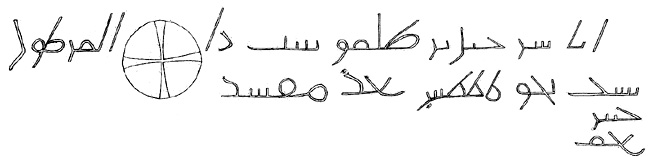
Ariel David writes about the researchers studying the inscriptions: “they did so very quietly perhaps because the context of the texts is something of an embarrassment to some. […] [Because of] the large, unmistakably Christian cross that decorates the head of this inscription.”
It is probably true that the coverage in the press has been little. But this is how it works in this cases: academic research can take long. Even more for such crucial inscriptions, that make scholars reconsider part of the history of the development of the (Nabateo-)Arabic script. As I said before, anyway, I attended a lecture in December 2014 exactly on the topic, and I did not notice any sort of reluctance in discussing the findings.
It is true also that there are no photos around of these inscriptions, they are not easy to find, but not because they are classified or impossible to get. I saw them during the lecture and I bet they have been published in the works and articles related to the study. If they are not online yet, is just how things work: copyrighted material, academic use… it is a matter of time. We also have to consider that the DASI (Digital Archive for the Study of pre-Islamic Arabian Inscriptions) is now working on the digitization of Nabatean inscriptions, among which, maybe, these ones will be added.
The cross also is not really bothering. There is at least one other pre-Islamic inscription in which a cross is displayed. It is dated to 568 CE, it was found in Harran, Syria, set in stone in a martyrium, with a beautiful and big cross right in the center of it. It has been widely recognized as a Christian inscription, written in Arabic.
The author of the Haaretz article probably confuses Arabic with Islam. Arabic is a language, that was and is still used by different communities. Islam is the religion which was not and is not practiced only by the Arab-speakers. My first lesson at the university was: what’s Arabic is not necessarily Islamic, what’s Islamic is not necessarily Arabic. The fact that a community of ‘Arabic’-speaker, before the birth of Islam, practiced another religion is not only acceptable but quite sure.
Conclusive note
As I said, I studied and analysed at length the polemic in the press about the Sana’a manuscripts. In that case, the discussion in the media exploded some 30 years after the discovery of the manuscripts (in 1972) with an article by Toby Lester in the Atlantic Monthly dated 1999. In that case, too, the author used biased words and did not even rely on the scarce academic information available at the time (the research was still in progress). In the article, Lester implied that researchers and authorities were willingly trying not to disclose information and facts, too. And from that article started a long-lasting polemic.
I do not know if this is the case, the article only appeared yesterday, but for sure the elements are there.
I do not claim at all that the academic research needs to be confined and ‘stay safe’ within the academic world, but I do think that an author will need to actually weigh the words he/she uses.
An article should be informative, not politically biased.
 SquareKufic
As the author of the article in question, allow me to address some of the points you raise.
I am well aware that Saudi Arabia is a modern nation state. The text of the article spells out that Himyar controlled “much of what is today Yemen and Saudi Arabia.” Of course that formulation is too long and cumbersome for a headline, but I do trust that our readers, especially those interested in this kind of article, will understand that with that headline we are referencing the geographical area that is today part of Saudi Arabia, rather than the current political entity. This isn’t bias, it is simply an editorial necessity.
As for your second point, my explanation of the reluctance of researchers to discuss this discovery outside of academic circles may be opinionated, but so is yours. And frankly, I don’t buy your argument that “research takes time” and there are issues of copyright etc. As I mention in the article, the inscriptions are already published and there is no reason why there should not be a picture of the inscription available to the general public or even a mention of its actual content.
As for your final point, I don’t quite understand how you got to the conclusion that I confuse Arabic and Islam. I do mention in the article (albeit briefly, given the space limitations) the other early Arabic-script inscriptions found in Syria, which date to 6th century — so it is made quite clear in the story that also these are pre-Islamic. In fact, the whole point of the article was to tell our readers a bit about the history of the region before Islam, specifically about Jewish/Christian Himyar and how the Arabic alphabet and culture were linked to that pre-Islamic context. Yes, this may be all accepted by scholars but it is not broadly known to the general public, and there are always new discoveries, like the Bir Hima one, which offer an occasion to report on this relatively ignored topic. Frankly, the nitpicking on the headline and the polemic tones kind of support the idea that some people are really bothered by the very telling of this story.
LikeLike
The title is simply false. It does not bother anyone. The Jewish Arabs were Arabs of Jewish religion as they could be Christians. Or at least the sovereigns were. This does not cause scandal. Islamic tradition and the Koran itself testify to the Jewish and Christian presence in Arabia.
In the 4th century there was a partial process of Judaization and the relative abandonment of pagan culture,[3] by will of the reigning Tubbaʿ dynasty, a phenomenon that – together with the conspicuous Christian presence in the great oasis of Najrān – has been seen as a precursor of the slow affirmation of the monotheistic conceptions of the Peninsula first and of the Ḥijāz later, without forgetting however the influence resulting from the occupation of the country by the Sassanid Persians in about 570 AD.
According to Arab, Syriac and Abyssinian traditions and documents, King Dhū Nuwās converted to Judaism, carrying out a violent persecution against Christians in 523. Christian sources insist on the episode of the siege of the city of Najrān, whose siege had no effect, inducing the king to promise that, if the Christians had opened their doors peacefully, he would not perpetrate any violence. This was not the case. When the city opened its doors to him, Dhū Nuwās ordered the massacre of those who had not abandoned the Christian faith and, as a warning, he dug up the body of Bishop Paul and burned it.
The Acta of Aretas of Najrān[4] recall the martyrdom of Aretas, one of the city’s notables, who was killed with 340 companions on 24 October 523. The hagiographic documents obviously read the episode of the siege in an exclusively religious light,[5] while they ignore the large debt contracted by the king towards the Christian merchants of the oasis and his difficulty (and feeble intention) to repay it.
Moreover, the Jewish presence in what is now Yemen (not Saudi Arabia, ignorant Zionist), led only to a serious massacre against the Christians.
The Himyarites originally worshipped most of the South Arabian pantheon, including Wadd, ʿAthtar, ‘Amm and Almaqah. At least from the reign of Malkikarib Yuhamin (c. 375–400 CE), Judaism was adopted as the de facto state religion. The religion may have been adopted to some extent even two centuries earlier, but inscriptions of polytheistic deities ceased after this date. It was embraced initially by the upper classes and, perhaps, by a large portion of the general population over time. [ 4 ] Native Christian kings ruled Himyar from 500 CE until 521–522 CE, and Christianity itself became the main religion after the Aksumite conquest in 530 CE. [ 8 ] [ 9 ] [ 10 ]
Conversion of King Abu Karib to Judaism
According to Arab legends and folklore, King Abu Karib (r. 390–420) was the first Jewish convert. His conversion is thought to have occurred following a military expedition into northern Arabia in an attempt to eliminate Byzantine influence, which had been trying to expand its influence into the peninsula. [ 24 ] He reached and conquered Yathrib (Medina) and installed his son as governor there. Later, he would learn that his son had been killed, and so he returned to besiege the city, during which the Jewish population fought against him. Abu Karib fell ill during the siege, but two Jewish scholars named Ka’b and As’ad managed to nurse him back to health. They also convinced him to lift the siege and make peace; subsequently, he and his army converted. When he returned home, he took the scholars back with him to the capital, where he managed to convince the population to convert as well. [ 25 ] After his death, it is said that a pagan, Dhū-Shanatir, ascended the throne since his sons, whom he had left to rule, were all still minors. [ 24 ]
Historically, however, Judaism itself was introduced during the reign of Malkikarib Yuhamin, the father of Abu Karib. [ 26 ]
The Rise of Dhu Nuwas and the Persecution of Christians in the Himyarite Kingdoms
In 470, the Himyarite king Sharhabil Yakkuf [ 27 ] ordered the execution of a Christian priest named Azqir for erecting a chapel with a cross in the city of Najran. [ 28 ]
By the year 500, during the reign of the Jewish monarch Marthad’ilan Yu’nim (c. 400–502) the kingdom of Himyar exercised control over much of the Arabian Peninsula.[ 29 ] It was around this time that the kingdom of Aksum invaded the peninsula, overthrowing the Himyarite king and installing the native Christian king, Ma’dikarib Ya’fur, in his place.[ 30 ][ 31 ][ 32 ] A Himyarite prince and hardline follower of Judaism, Dhu Nuwas (who had attempted to overthrow the dynasty several years earlier), seized power after Ma’dikarib Ya’fur had died via a coup, assuming authority after killing the Aksumite garrison at Zafār. He went on to engage the Ethiopian guards and their Christian allies in the coastal plains of Tihāma facing Abyssinia. After taking the port of Mukhawān, where he burned the local church, he advanced south to the fortress of Maddabān overlooking the Bab-el-Mandeb, where he expected Kaleb Ella Aṣbeḥa to land with his fleet. [ 20 ] The campaign ultimately killed between 11,500 and 14,000 people and took a similar number of prisoners. [ 29 ] Mukhawān became his base, while he sent one of his generals, a Jewish prince named Sharaḥ’īl Yaqbul dhu Yaz’an, against Najrān, a predominantly Christian oasis, with a good number of Jews, who had supported his previous rebellion with troops, but refused to recognize his authority after the massacre of the Axumite garrison. The general blocked the caravan route connecting Najrān with eastern Arabia. [ 20 ]
The End of Jewish Rule in Himyar
Dhu Nuwas continued to militarily combat the Christianizing influence of the Kingdom of Aksum and massacred the Christian community of Najran,[ 33 ][ 34 ][ 35 ][ 36 ] which is partly documented by an inscription made by Sarah’il Yaqbul-Yaz’an, Ja 1028, which describes the burning of a church and the massacre of Abyssinians (Ethiopian Christians), resulting in thousands of deaths and prisoners. These events are also discussed in several contemporary Christian sources: in the writings of Procopius, Cosmas Indicopleustes, John Malalas and Jacob of Serugh. Shortly thereafter, John of Ephesus (d. 588) recounted a letter from another contemporary, Mar Simeon, addressed to Abbot von Gabula about the events. Additionally, an anonymous author produced the Book of the Himyarites, a 6th-century Syriac chronicle of the persecution and martyrdom of the Christians of Najran. This event led to a significant counterattack by the Ethiopian kingdom, resulting in the conquest of Himyar in 525–530 and the final defeat and deposition of Dhu Nuwas. This meant the end of Jewish leadership of southern Arabia,[37] and Kaleb appointed a Himyarite Christian, Sumyafa Ashwa, as his viceroy and vassal ruler of Himyar.[38]
Jews have a frightening protagonism problem.
LikeLike
Giulia, your response to the article is petty as the assumptions you make about another’s knowledge is amateurish and perhaps political. Anyone discussing these issues is well aware that Saudi Arabia is a post WW1 creation and that Arab is not Islam. Your commentary wasted my time,
LikeLike
Hi Peter, sorry to hear you felt you wasted your time reading the blog. Hope you’ll find something more interesting another time. In any case, I thank you for sharing your opinion.
LikeLike